Today in Henry Laurens, February 28, 1766

Henry penned a letter from Charles Town to his wife’s nephew, Elias Ball, Jr. (often called Elias Ball of Wambaw or Wambaw Elias).1 Ball family biographer, Anne Simons Deas, reported in the early twentieth-century that he was a “man over-bearing, selfish, arrogant, lavish of sneers and criticism, and not over-considerate of other people’s feelings. Modern Ball family biographer, Edward Ball, related a story his father told about Wambaw Elias. “He had about a hundred and fifty slaves,” his dad related, “and he was a mean fella.” The crux of the story is that Wambaw Elias had been a Tory, remaining loyal to Britain. Charles, Lord Cornwallis had given him the rank of colonel and a company of men. He had “fought the patriots and burned their houses until such time as the British lost and his victims called for revenge.”2

Of course, that may have been the rub: Wambaw Elias chose the wrong side, and his character was judged after he crossed the Rubicon, but he also might have been both a Loyalist and a man of poor rectitude.

Wambaw Elias Ball, the Gibbes museum of art.

Henry had been co-owner of a plantation on Wambaw Creek with Elias’s father, John Coming Ball. The letter’s primary purpose was a discussion of the division of “Cattle, Horses, &ca., as we undivided of the joint property of your late Father & me.”

Henry’s irritation with Elias’s actions is palpable, and it is quite clear that he would have never entered into a business relationship with Wambaw Elias, who did not possess his father’s business acumen. Moreover, he likely failed to inherit his father’s amiability.3 Regardless, Henry remained cordial: “Please to present my Love to your partner, to your Mamma, & all the Children.”

  1. Henry Laurens to Elias Ball, Jr., Charles Town, February 28, 1766, Papers of Henry Laurens, 5:81-83. ↩︎
  2. Anne Simons Deas, Recollections of the Ball Family of South Carolina and The Comingtee Plantation (Charleston, 1909), 100-112, especially page 111 and Edward Ball, Slaves in the Family (New York, 1998), 8-9. For an example of Ball’s fighting, see Ian Sabteron, ed., The Cornwallis Papers: The Campaigns of 1780 and 1781 in The Southern Theatre of the American Revolutionary War (East Sussex, 2010), 26, 64, 66-67, 70, 92, 209, 220, 244, 266, and 359. ↩︎
  3. Anne Simons Deas, Recollections of the Ball Family of South Carolina and The Comingtee Plantation (Charleston, 1909), 91-95. ↩︎
Today in Henry Laurens, February 27, 1772

From Westminster, Henry responded to Bristol merchant William Cowles’s letter of the twenty-fifth.1 Henry repeated his wish that Cowles not financially inconvenience himself on Laurens’s behalf. Nor would I, my good friend,” Henry wrote, “desire you to accept any other Bills on my account unless quite agreeable & convenient to your own affairs. I would by no means put you to the smallest difficulty.” To prevent future “inconveniencies,” Henry “signified an inclination to sell off my parts of all the Deer Skins.” Additionally, he wrote John Tarleton, from Liverpool, owed him £5,000. He closed by wishing Cowles a “speedy recovery of health.”


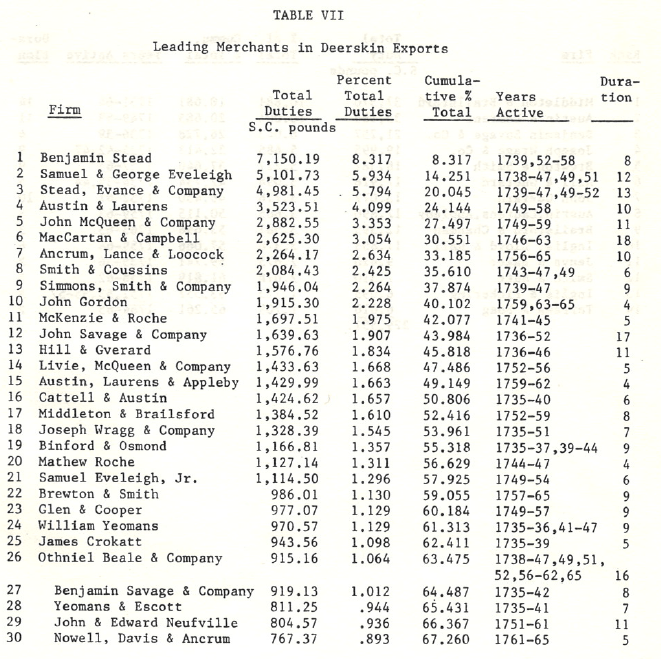
Stuart O. Stumpf and Jennings B. Marshall, “Leading Merchants of Charleston’s First ‘Golden Age,’” in Essays in Economics and Business History (1986), volume 4.

John Tarleton was the merchant father of the infamous Green Dragoon, Banastre Tarleton. John would die the next year and bequeathed £5,000 to his nineteen-year-old son, which he mostly squandered.2 In several years, the son would wreak hell upon South Carolina, most notably at the Battle of Waxhaws.3

Again, we witness the very personal nature of the merchants’ craft, at least as practiced by Henry Laurens. Henry believed in only working with those with whom he cultivated a friendly personal, as well as professional, relationship.4

  1. Henry Laurens to William Cowles, Westminster, February 27, 1772, Papers of Henry Laurens, 8:191-192. ↩︎
  2. Robert D. Bass, The Green Dragoon: The Lives of Banastre Tarleton and Mary Robinson (New York, 1957), 14-16. ↩︎
  3. Lawrence E. Babits, A Devil of a Whipping: The Battle of Cowpens (Chapel Hill, 1998); John Buchanan, The Road to Guilford Courthouse: The American Revolution in the Carolinas (New York, 1997); John Pancake, This Destructive War: The British Campaign in the Carolinas (Tuscaloosa, 1985); Anthony J. Scotti, Brutal Virtue: The Myth and Reality of Banastre Tarleton (Berwyn Heights, 2002); and Banastre Tarleton, A History of the Campaigns of 1780 and 1781, in the Southern Provinces of North America (London, 1787). ↩︎
  4. David Hancock, Citizens of the World: London Merchants and the Integration of the British Atlantic Community, 1735-1785 (Cambridge, 2009), introduction. ↩︎

Today in Henry Laurens, February 26, 1776

Henry accepted William Henry Drayton’s offer to assist the “smaller Armed Vessels” in Charles Town harbor with the Prosper.1 Henry said the Council of Safety (the 2nd such council in South Carolina), of which he was the president) had judged it to be “very necessary for the public service immediately to equip these Vessels for Cruizing on the Coast [and] we desire you will order Thirty such Men on board the Brig[antine] Comet,” under the command of Captain Joseph Turpin, part owner of the schooner Molly.2

Unnamed, The Charleston Museum.

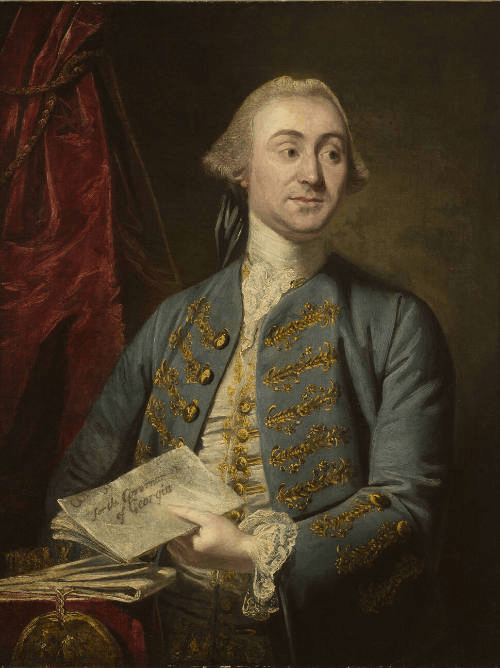
There was reason for concern these days. British vessels had been spotted off the coast of Charles Town and Savannah in January and February. Their presence off the coast of Savannah the previous month had compelled Georgia’s Council of Safety to arrest royal Governor Sir James Wright.3

James Wright, attributed to Alexander Soldi, undated, Telfair Museum.

British vessels remained off the Lowcountry coast for months, engaging Georgia’s Rebels in the Battle of the Riceboats (Rice Boats) in early March before attacking Charles Town (Fort Sullivan) at the end of June.4 Although the Georgians lost the Battle of the Riceboats, South Carolinians, led by Colonel William Moultrie, repelled the British offensive.5 The fort was renamed Fort Moultrie shortly after the battle.

  1. Henry Laurens to William Henry Drayton, Charles Town, February 26, 1776, Papers of Henry Laurens, 11:121-122. ↩︎
  2. Ibid. ↩︎
  3. Greg Brooking, From Empire to Revolution: Sir James Wright and the Price of Loyalty in Georgia (Athens, 2024), ch. 6. ↩︎
  4. Ibid., 152-154. ↩︎
  5. Jim Stokely, Fort Moultrie: Constant Defender (Washington, 1985); David Wilson, The Southern Strategy: Britain’s Conquest of South Carolina and Georgia, 1775-1780 (Columbia, 2005), ch. 4; John Buchanan, The Road to Guilford Courthouse: The American Revolution in the Carolinas (New York, 1997), ch. 1. ↩︎

Today in Henry Laurens, February 25, 1766

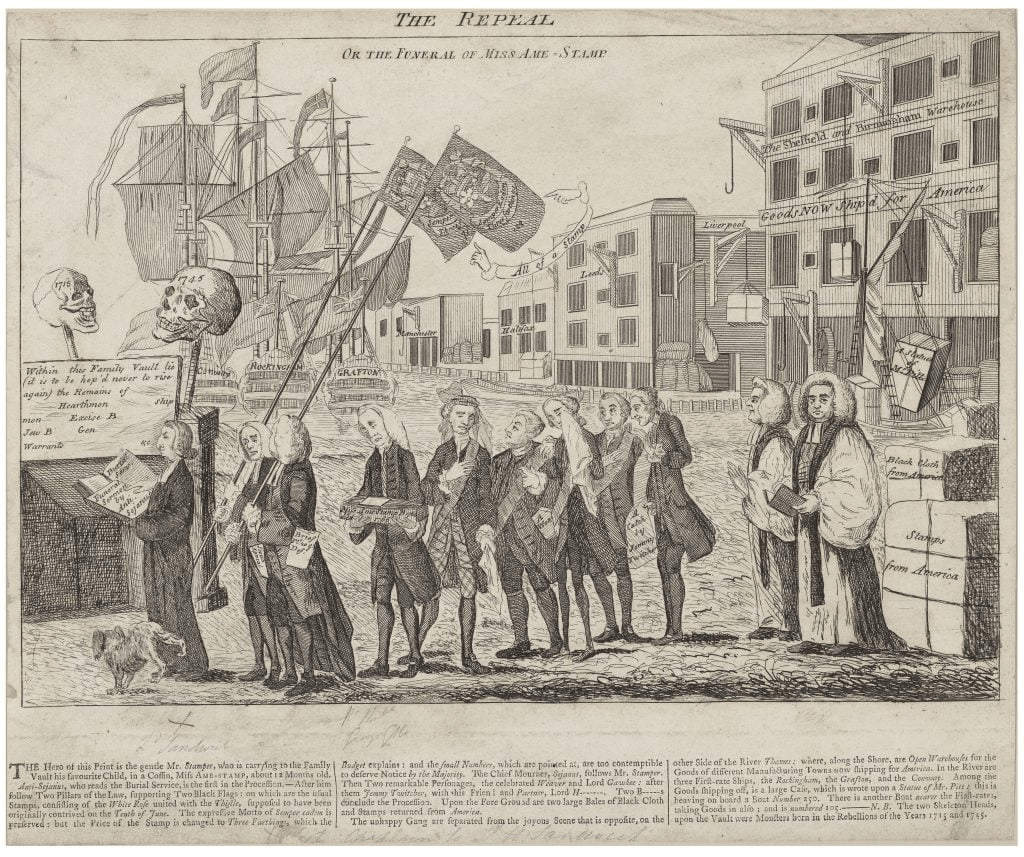
South Carolina’s colonial agent (lobbyist), Charles Garth, reported the House of Commons decision to repeal the Stamp Act (1765). However, it still had to clear an official vote in the Commons and the House of Lords. Garth expected the Commons to pass the bill easily but warned of heavy opposition in the House of Lords.1

The Repeal, by Benjamin Wilson (The British Museum)

As historian Maurice Crouse noted, South Carolina’s opposition to the Stamp Act was cautious but effective. “Except for the several mob actions which were destructive of property,” South Carolinians had protested “without materially violating that or any other law.”2

From Savannah, however, Georgia’s Governor James Wright interpreted South Carolina’s response quite differently. He was all too familiar with Charles Town’s radicals and their decisions to hang three effigies from a gallows outside Dillon’s Tavern.3 “Too much of the rebellious spirit in the northern colonies has already shewn itself here,” Wright wrote to the ministry, and Georgians have been for “many months past stimulated by letters” sent from the other colonies, especially South Carolina, whose “seditious spirit” had infected the colony.4

Ultimately, though, a cross-class consciousness and acceptance of a stable social hierarchy emerged during the Stamp Act crisis. “Class interest,” Robert Weir noted, “extended merely to the protection of interests legitimately within the proper sphere of that class,” even if social mobility existed individually.5 Thus, South Carolinians believed in a hierarchical society that equally protected all property. Notably, the wealthy would serve as caretakers, governing for the common good.6

  1. Charles Garth to the Committee of Correspondence, London, February 25, 1766, Papers of Henry Laurens, 5:76. ↩︎
  2. Maurice A. Crouse, “Cautious Rebellion: South Carolina’s Opposition to the Stamp Act,” The South Carolina Historical Magazine 73, no. 2 (April 1972), 70-71. ↩︎
  3. Daniel J. McDonough, Christopher Gadsden and Henry Laurens: The Parallel Lives of Two American Patriots (Cranbury, 2000), 69. ↩︎
  4. Greg Brooking, From Empire to Revolution: Sir James Wright and the Price of Loyalty in Georgia (Athens, 2024), 66 and 73. ↩︎
  5. Robert M. Weir, “Liberty and Property, and No Stamps”: South Carolina and the Stamp Act Crisis” (Ph.D. diss., Western Reserve University, 1966), 15. ↩︎
  6. H. L. to James Marion, Mepkin, August 31, 1765, Papers of Henry Laurens, 4:671-672. ↩︎

Today in Henry Laurens, February 24, 1756 (Part II)

Posted on 

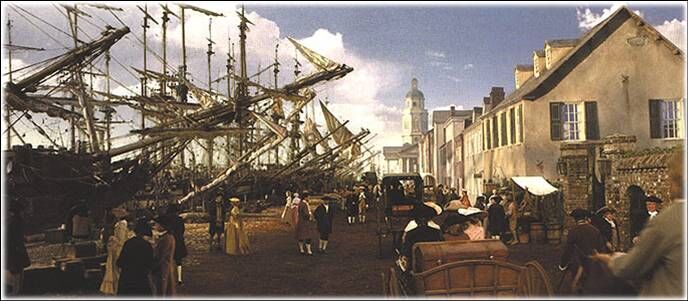
Still from the movie, The Patriot, showing Tradd Street (on the right) with some Hollywood CGI magic”

Today, Henry penned a letter to Mayne, Burn, & Mayne of Lisbon, Portugal, in response to their letter of November 22, 1755 (not found). However, Henry’s letter makes clear the subject of that letter.1

Henry expressed his joy that they “had escaped unhurt … in that shocking misfortune with which your City was attended the first of November.”

At 9:40 in the morning on the first of November, 1755, on the Feast of All Saints, a 7.7 earthquake (known as the Great Lisbon earthquake) rocked Lisbon. With its epicenter in the Atlantic Ocean, the quake caused a tsunami that engulfed Lisbon’s downtown area, causing significant flooding and a long-burning fire.

“It cannot be doubted,” Henry continued, “that your losses … must have been very great but then you are infinitely more happy than many others who must have lost their all & perhaps some of their Family or Friends.” Henry then imagined the devastation. “We are of the opinion,” he surmised, “this has been the most violent convulsion of the Earth that ever has happen’d…. The whole Atlantick Ocean we immagine must have been agitated as the Tide ebb’d and flow’d.”

In this moment, Henry must have contemplated the eight hurricanes that hit South Carolina in his lifetime, especially the Great Hurricane of 1752, from which the province had not yet recovered, physically or politically.

Fortunately, he noted, it was great news that “your Rice was preserv’d to help the distresses of the poor.

But, as was often the case with Henry, conversations always returned to commerce. “Crops of Rice this Year won’t exceed 70,000 Barrells,” he wrote, but “Last Year we ship’d 110,000 Barrels.” He then commented about the supply and demand of rice and wheat, before closing with a personal note.

“We wish you a return of many happy Years ’till the Memory of this fatal Catastrophe shall be totally effaced.” This is quintessential Henry Laurens. His business was personal. He carefully chose his business partners. They were honest men who could be relied upon and with whom he had cultivated caring personal relationships. Such connections, historian David Hancock has argued, were essential to integrating the 18th-century of the British-Atlantic.

  1. Henry Laurens to Mayne, Burn, & Mayne, Charles Town, February 24, 1756, Papers of Henry Laurens, 2:104-105. ↩︎

Today in Henry Laurens, February 24, 1724 (Part I)

Henry Laurens was born on this day (O.S.). in Charles Town, South Carolina, to Jean Laurens and Esther Grasset.

Of Huguenot extraction, Jean Laurens was born in New York City before settling in the Lowcountry. He married Esther, also an American-born Huguenot, in New York City.

He was a saddler by trade but accumulated enough wealth to become a landowner and active member of his religious and social communities.