From Westminster, Henry responded to Bristol merchant William Cowles’s letter of the twenty-fifth.1 Henry repeated his wish that Cowles not financially inconvenience himself on Laurens’s behalf. Nor would I, my good friend,” Henry wrote, “desire you to accept any other Bills on my account unless quite agreeable & convenient to your own affairs. I would by no means put you to the smallest difficulty.” To prevent future “inconveniencies,” Henry “signified an inclination to sell off my parts of all the Deer Skins.” Additionally, he wrote John Tarleton, from Liverpool, owed him £5,000. He closed by wishing Cowles a “speedy recovery of health.”
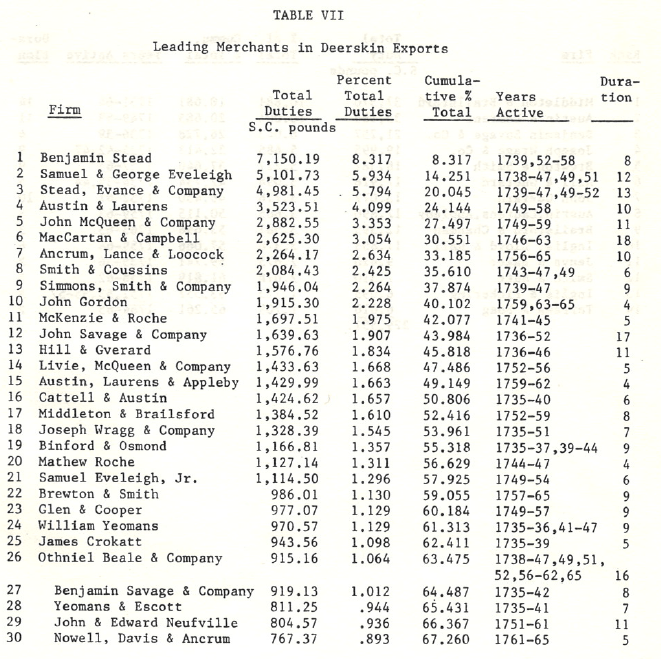
Stuart O. Stumpf and Jennings B. Marshall, “Leading Merchants of Charleston’s First ‘Golden Age,’” in Essays in Economics and Business History (1986), volume 4.
John Tarleton was the merchant father of the infamous Green Dragoon, Banastre Tarleton. John would die the next year and bequeathed £5,000 to his nineteen-year-old son, which he mostly squandered.2 In several years, the son would wreak hell upon South Carolina, most notably at the Battle of Waxhaws.3
Again, we witness the very personal nature of the merchants’ craft, at least as practiced by Henry Laurens. Henry believed in only working with those with whom he cultivated a friendly personal, as well as professional, relationship.4
- Henry Laurens to William Cowles, Westminster, February 27, 1772, Papers of Henry Laurens, 8:191-192. ↩︎
- Robert D. Bass, The Green Dragoon: The Lives of Banastre Tarleton and Mary Robinson (New York, 1957), 14-16. ↩︎
- Lawrence E. Babits, A Devil of a Whipping: The Battle of Cowpens (Chapel Hill, 1998); John Buchanan, The Road to Guilford Courthouse: The American Revolution in the Carolinas (New York, 1997); John Pancake, This Destructive War: The British Campaign in the Carolinas (Tuscaloosa, 1985); Anthony J. Scotti, Brutal Virtue: The Myth and Reality of Banastre Tarleton (Berwyn Heights, 2002); and Banastre Tarleton, A History of the Campaigns of 1780 and 1781, in the Southern Provinces of North America (London, 1787). ↩︎
- David Hancock, Citizens of the World: London Merchants and the Integration of the British Atlantic Community, 1735-1785 (Cambridge, 2009), introduction. ↩︎
Discover more from Greg Brooking, PhD
Subscribe to get the latest posts sent to your email.
 Greg Brooking, PhD