Thoughts from a Biography in Progress: Henry Laurens on Christmas Day, 1763

Henry Laurens spent Christmas morning 1763 in much the same way he spent every other day that monumental year, and in much the same way the western world does in the twenty-first century: conducting business.1 Highlighting the patience required in a transatlantic eighteenth-century world, Henry explained that since he last wrote to the firm in June, he received their letter from May. He had hoped to receive a reply to his June letter before writing back, but he was now running out of patience.

Colonial Christmas at Walnut Grove (Spartanburg, SC, History)

He got to the point, telling them he agreed to their price for their bale strouds, a woolen fabric especially prized by Native Americans. The product, however, arrived damaged, making it unsaleable except by vendue (public auction).
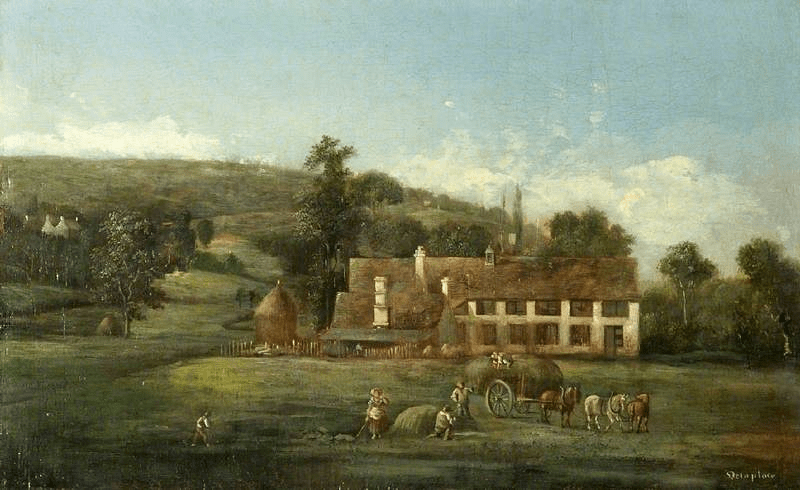
Hope Mill in Stroud, Gloucestershire, by Gerardin Delaplace (Stroud Woolen Mills)

Henry stated that such damage has been all too common of late and extended to “Negro cloth & duffils,” something the “packers must have been privy to.” Thus, there is a chink in the supply chain.

Maintaining the cordiality needed for eighteenth-century commerce, Henry closed: “I have no great offers to make … but, if ever you have occasion of my service [in South Carolina] you may be assured of my inclination to approve.”

  1. Henry Laurens to Devonshire & Reeve, Charles Town, December 25, 1763, Papers of Henry Laurens, 4:107-108. ↩︎
Today in Henry Laurens, February 24, 1756 (Part II)

Posted on 

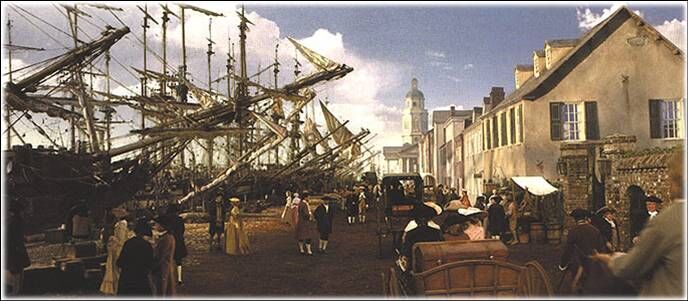
Still from the movie, The Patriot, showing Tradd Street (on the right) with some Hollywood CGI magic”

Today, Henry penned a letter to Mayne, Burn, & Mayne of Lisbon, Portugal, in response to their letter of November 22, 1755 (not found). However, Henry’s letter makes clear the subject of that letter.1

Henry expressed his joy that they “had escaped unhurt … in that shocking misfortune with which your City was attended the first of November.”

At 9:40 in the morning on the first of November, 1755, on the Feast of All Saints, a 7.7 earthquake (known as the Great Lisbon earthquake) rocked Lisbon. With its epicenter in the Atlantic Ocean, the quake caused a tsunami that engulfed Lisbon’s downtown area, causing significant flooding and a long-burning fire.

“It cannot be doubted,” Henry continued, “that your losses … must have been very great but then you are infinitely more happy than many others who must have lost their all & perhaps some of their Family or Friends.” Henry then imagined the devastation. “We are of the opinion,” he surmised, “this has been the most violent convulsion of the Earth that ever has happen’d…. The whole Atlantick Ocean we immagine must have been agitated as the Tide ebb’d and flow’d.”

In this moment, Henry must have contemplated the eight hurricanes that hit South Carolina in his lifetime, especially the Great Hurricane of 1752, from which the province had not yet recovered, physically or politically.

Fortunately, he noted, it was great news that “your Rice was preserv’d to help the distresses of the poor.

But, as was often the case with Henry, conversations always returned to commerce. “Crops of Rice this Year won’t exceed 70,000 Barrells,” he wrote, but “Last Year we ship’d 110,000 Barrels.” He then commented about the supply and demand of rice and wheat, before closing with a personal note.

“We wish you a return of many happy Years ’till the Memory of this fatal Catastrophe shall be totally effaced.” This is quintessential Henry Laurens. His business was personal. He carefully chose his business partners. They were honest men who could be relied upon and with whom he had cultivated caring personal relationships. Such connections, historian David Hancock has argued, were essential to integrating the 18th-century of the British-Atlantic.

  1. Henry Laurens to Mayne, Burn, & Mayne, Charles Town, February 24, 1756, Papers of Henry Laurens, 2:104-105. ↩︎